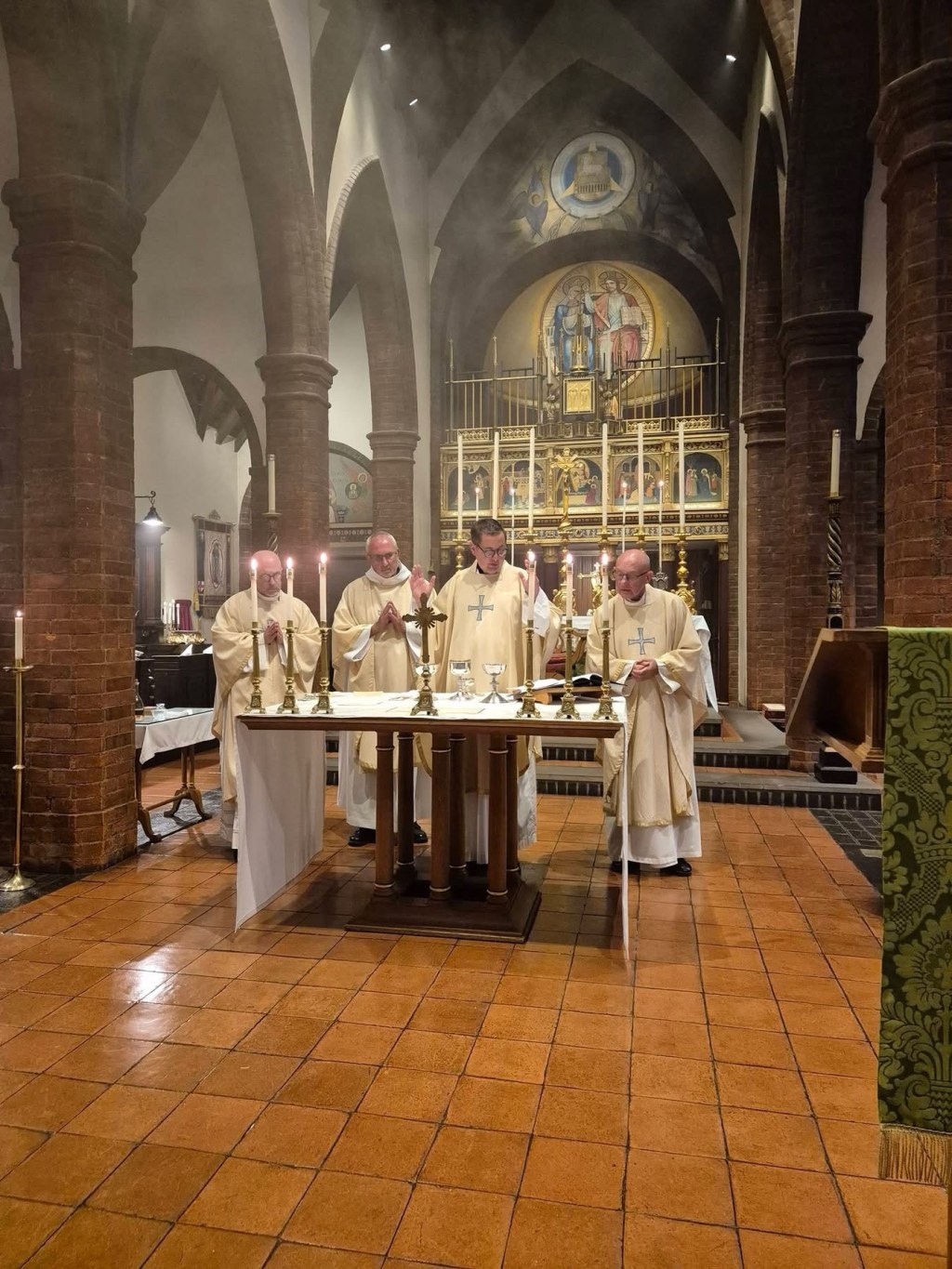
On Monday evening, Fr Richard set the scene for our pilgrimage by exploring Mary’s son with a message that turns the world on its head, which is the right way up!
Well friends, have you had a good journey to Walsingham? Was anyone sick on the way? Who had to stop for a wee more than three times? It must be a sign of getting old, but I used to be able to get to Walsingham with one stop – not anymore. Anyone argue over what to listen to in the car? Personally I don’t think you can beat the 6-CD box set of the collected sermons of Fr Ben Andrews! Most importantly of all, how was your driver? I’m sure those of you on the coach had a very smooth ride from Edwards’s finest, but what about those of you entrusting your life to a friend or partner? To quote Dustin Hoffman’s character Raymond in the film Rain Man, I’m an excellent driver, so Matt Batten was in very safe hands. He also reckons my taste in music and choice of in-car snacks is second to none.
But imagine if you were happily driving along the motorway from South Wales to Walsingham and all of a sudden whenever you turned the steering wheel to the left, the car went right, and vice versa. And as if that wasn’t bad enough, the pedals decided to swap over, so every time you pressed the brake the car went faster, and every time you stepped on the gas, it stopped dead. Suddenly you find yourself living in a topsy-turvy, back-to-front kind of world. It would be confusing, scary, and even dangerous. But after a while, you might start to get the hang of it – turning right to go left, and pressing the brake to go faster. With a bit of practice you might be able to adjust to the new reality.
Mary’s wonderful song, the Magnificat, takes us into a topsy-turvy, back-to-front world, a world which we are called upon to embrace during our precious days here in Walsingham and then when we return (hopefully safely!) to our daily lives. It’s topsy-turvy and back-to-front because Mary speaks of a world where those normally in control – those full of pride, the rich, and the mighty – are scattered, brought down and sent away empty. Instead, those who are normally at the bottom of the pile, without power, without status, without influence, are honoured, exalted, and lifted up. The tables are turned for sure. Mary’s words speak both about what God has done in the past and what he will do in the future. Throughout the Old Testament, God is continually seen as being on the side of the poor, the lowly and the disadvantaged. He has no time for those who use their power and wealth to oppress and humiliate others. But the Magnificat is also a promise – a vision of God’s kingdom which is breaking into this world thanks to Mary’s “yes” in agreeing to become the mother of his only Son. And of course, the Magnificat values are shown beautifully in her own story. God did not choose the mother of his Son based on wealth or status, but on her simple faithfulness and devotion.
Just like driving a car where the controls have been reversed, entering the topsy-turvy Magnificat world can be disconcerting at first. We are so used to living in a world where the rich call the shots and the poor count for nothing. To have that turned round feels weird. It can also be dangerous, for the powers-that-be always want to protect themselves. In fact, so dangerous are Mary’s words that various regimes have even had them banned. When Bibles were given to British-owned slaves in the Caribbean in the 1800s, the Magnificat had been removed unless the slaves got ideas about exalting the lowly and bringing down the mighty. In the 1980s, the military government of the central American country of Guatemala banned public recitation of the Magnificat because it was being seen by the country’s poor and dispossessed as a source of hope that things might change. Dietrich Bonhoeffer, the anti-Nazi dissident, pastor and theologian, described the Magnificat as “the most revolutionary hymn ever sung”.
So it might be a little confusing at first, being part of this Magnificat-inspired world. It might even be dangerous for the vested interests and those who oppress others. But again, like with our back-to-front car, over time we can get used to this new way of living, this new set of values outlined by Mary but always present in God’s dealings with his people. And of course, we see those values lived out most perfectly in the life of her Son, the one who emptied himself, who came to seek out the lost and the sinner, who rattled the cages of the powerful, who overturned the tables in the Temple, and came not to be served but to serve, and gave his life as a ransom for many. In our pilgrimage this week we are called to become more and more like Jesus and so more and more used to living in the topsy-turvy world that Mary proclaims.
And then we are called to spread the revolution so that the world described in the Magnificat becomes a reality. But our revolution doesn’t begin on protest marches or at barricades. It begins right over there, in that simple dwelling, the Holy House, where we sit at Mary’s feet and hear her words afresh once more. It begins as we listen to a woman who knows what it is like to be treated like trash, for her precious Son to be nailed to a Cross like the lowest of the low. But she also knows what it is like to endure all of this and still be called blessed among women. Our weapons for this revolution are not sticks and clubs and guns; they are our prayers, our Masses, our saying of the Rosary and our processions. These are the ways we witness to the new world that God announces in his Son, and which Mary tells us about in her song.
I’ve been talking along about a topsy-turvy, back-to-front world described in the Magnificat. But in reality, it is the world the right way round, the world the way it is meant to be, the world that God intended and intends for all his people, where all are honoured, all are loved, all are included, and all are fed. This is God’s kingdom which we catch a glimpse of here in Walsingham and whenever we gather together as Christian communities to pray, to worship and to serve others. So, I hope you had a smooth ride here today. I hope this week will be one of great blessings where we rediscover again what it means to live as Magnificat people. And then I hope you have a smooth ride home. But let us pledge not to give a smooth ride to those who would oppress the needy or trample on the poor. Let us be those people who play our part in turning this world upside down, which is really the right way up.


Leave a Reply