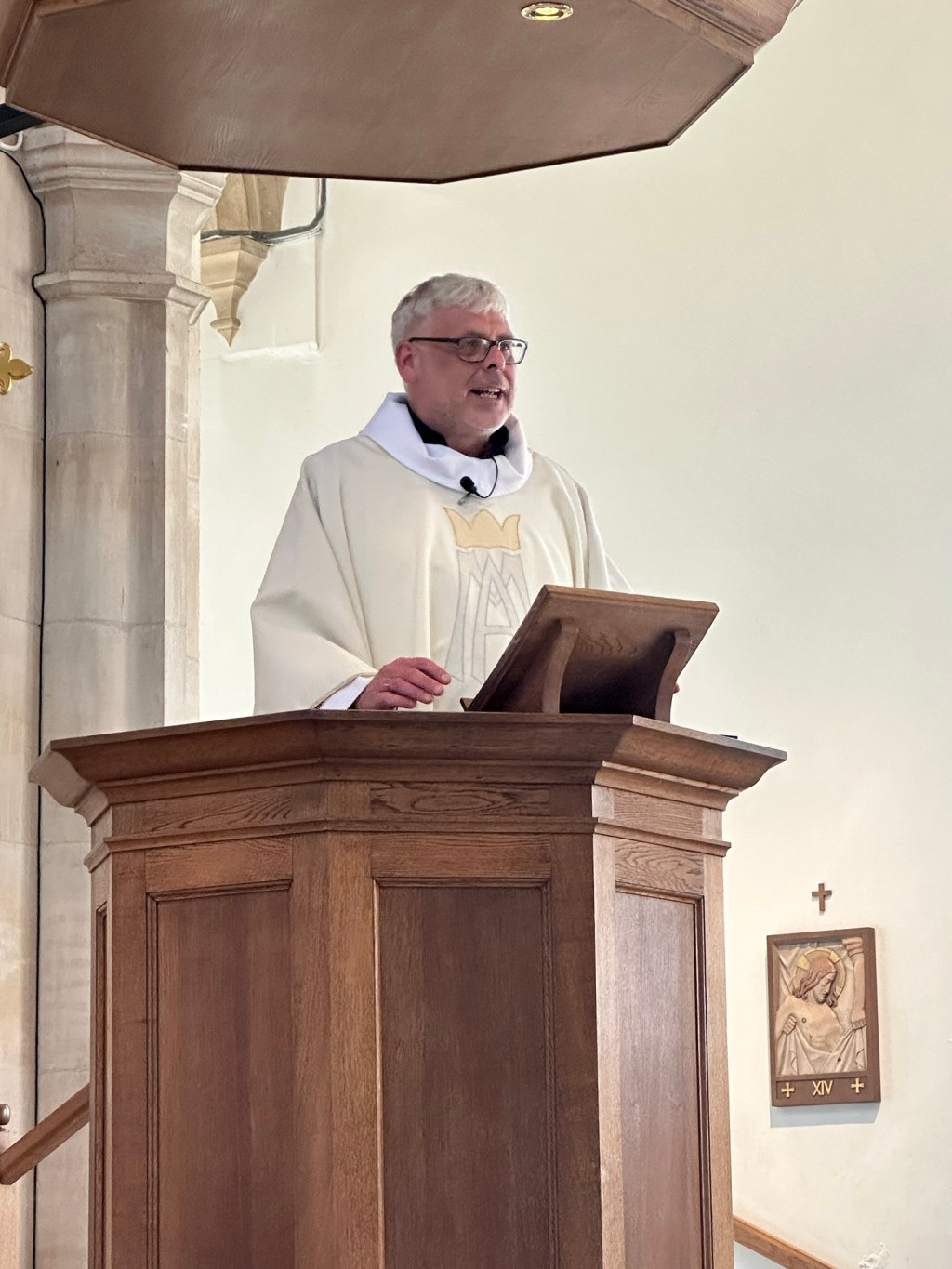
On Wednesday Morning we celebrated a Mass of Our Lady of Walsingham at the Parish Church, and explored a rediscovered sense of awe and wonder.
I remember as a child and teenager, during the summer months, particularly after a fall of rain, slugs would emerge from hiding places, seeking something to eat. We didn’t have to worry about them eating the garden as flowers or any other fruits were hard to come by in our back yard, battered by three brothers playing football.
But the slugs didn’t have to look too far for food because I discovered they loved a soft pear or a piece of apple freshly picked from the fruit bowl and which I’d place outside the patio doors. In typical slug style they slowly moved their way across the patio in an army of slime, and I watched them in detail, close up, night after night, as their mouthpieces worked away at the flesh.
Now some people may think that quite strange. What a weird child I must have been, fascinated by slugs, feeding those whom many people would have salted away. But I was kind of in awe of them. I was filled with wonder.
And so last year, I loved reading the memoir of Chris Packham, the naturalist, as he shares something of his growing up as an autistic child in a world that didn’t understand him.
In a beautiful passage, he writes of when as a child he lies down on the ground, with “his cheek on the warm earth.” In the third person he describes himself:
“He was lying on a tablet of riches, his wilderness explored: he knew the plains, the forests, the canyons intimately and where all life lived and hid, the boulders that covered the scaly caverns of wood lice, where quick twisty centipedes were shiny and soft beneath his fingers, the lovely bark where tiny specks of crimson ran and stained those fingers dead red, the corners where secret spiders stood motionless on their soft handkerchiefs and the lake, the pool, the baby bath, a muddy cradle in which many miracles swam.”
A muddy cradle in which many miracles swam.
Is it all too easy to lose a sense of wonder, or to have it squeezed out of us? Would we prefer to salt a slug to death than marvel in its glory. Do we take too much for granted? Or remain ignorant of the world of which we are a part? Do we shy away from the muddy cradle in which so many miracles swim?
Our life of course is often muddy, the world even muddier. We may even say it’s a bit of a mess, beyond belief. Environmental disaster, political instability, war and civil unrest, poverty and deprivation, homelessness and a world where we lock horns with one another, turn our back on the stranger, and back the ones who are different from us into a corner. Yes, the world is very muddy.
Remember the mud and the miracles as I tell you this next story.
It’s the story Antoine Leiris, whose life exploded on a November night in 2015 as he was looking after his baby son. On that night, his wife Helene was killed along with 88 other people at the Bataclan Theatre in Paris. Three days later he wrote an open letter to his wife’s killers on Facebook. “For as long as he lives this little boy will insult you with his happiness and freedom. You will not have my hate.” In the book of the same name, he writes of those days and months afterwards.
“I hold him against my body,” he says, “trap him between my legs, so he can feel me, understand me. He spent nine months inside his mother, listening to her live: her heartbeat was the rhythm of his days, her movements were his journey, her words the music of his nascent life. I want him to hear, his ear to my chest, my voice telling him my sorrow. I want the beating of my heart to reassure him: life will go on.”
I once read that an unborn child’s heart beats to the rhythm of his mother’s. Mary and Jesus move to the same rhythm, their bodies in tandem, his heartbeat following hers, his kicks stirring her to the presence of God.
As she smells the top of her newborn baby’s head she inhales the Divine, wraps him tightly in strips of cloth, places him in a makeshift crib, a muddy cradle, and watches in wonder as strangers emerge from the dark hills to discover the miracle.
They smell of the warm earth, and sheep, of the night. Unclean visitors whose lives have been turned around. And they cannot keep silent. Thanks to them, the rumours of God reverberate around the neighbourhood. People hear the echoes of God as they unfold the details of their discovery as a mother unwraps the swaddling clothes of her newborn baby boy.
How do we recognise the divine? Where do we find God? In the song of angels and bright lights? Alas, those sights are rare to find.
More likely, we find God in what appears to be mundane and ordinary. In a full house, a displaced family, far from home, pawns of political decisions, victims of circumstance, in a muddy cradle.
The angels’ message is just a preamble to what is really important. The shepherds could have been so caught up in their beautiful experiences of angelic song and heavenly encounter and sought out a similar experience, another high or hit. Instead, they head to the streets, to a house full of people, to a muddy cradle.
And where does that leave us?
We need to find the glimmer, the sparkle, the light, the moment that makes everything make sense. We need to peer into the muddy cradle where miracles swim.
That cradle of mud will mean different things to all of us. Personal difficulties, anxiety over a loved one, job insecurity, depression and difficulties, workloads and heavy responsibilities, ill health, strains in a relationship, or just an undefined feeling of not being at ease.
Sometimes, the miracle we seek can be so small that it gets overlooked. So seemingly insignificant that we can pass it by unnoticed, left to swim around unseen, unknown, in the muddy cradle.
We need to stop and look and peer into what is there.
The shepherds left the light filled sky at night, and a chorus of perfect song. Somehow, they moved on and sought and saw the miracle of the muddy cradle, the one whom their heart loved. The one who raised Mary’s heartbeat as she was caught up in utter love of her child. Mary, whose heart was slowly being filled with treasures, day by day. Mary, whose own heart beat to the rhythm of God’s.
I quite understand if staring at a slug doesn’t do it for you, but you can discover what does. There is awe to be found in all that God has created. We find it in the muddy cradle, whatever that means to you. But we do have to find it. It is there is be discovered. So be gentle and patient, alert and attentive, aware and in awe. Go and find it.
 Enter the Mystery
Leave a comment