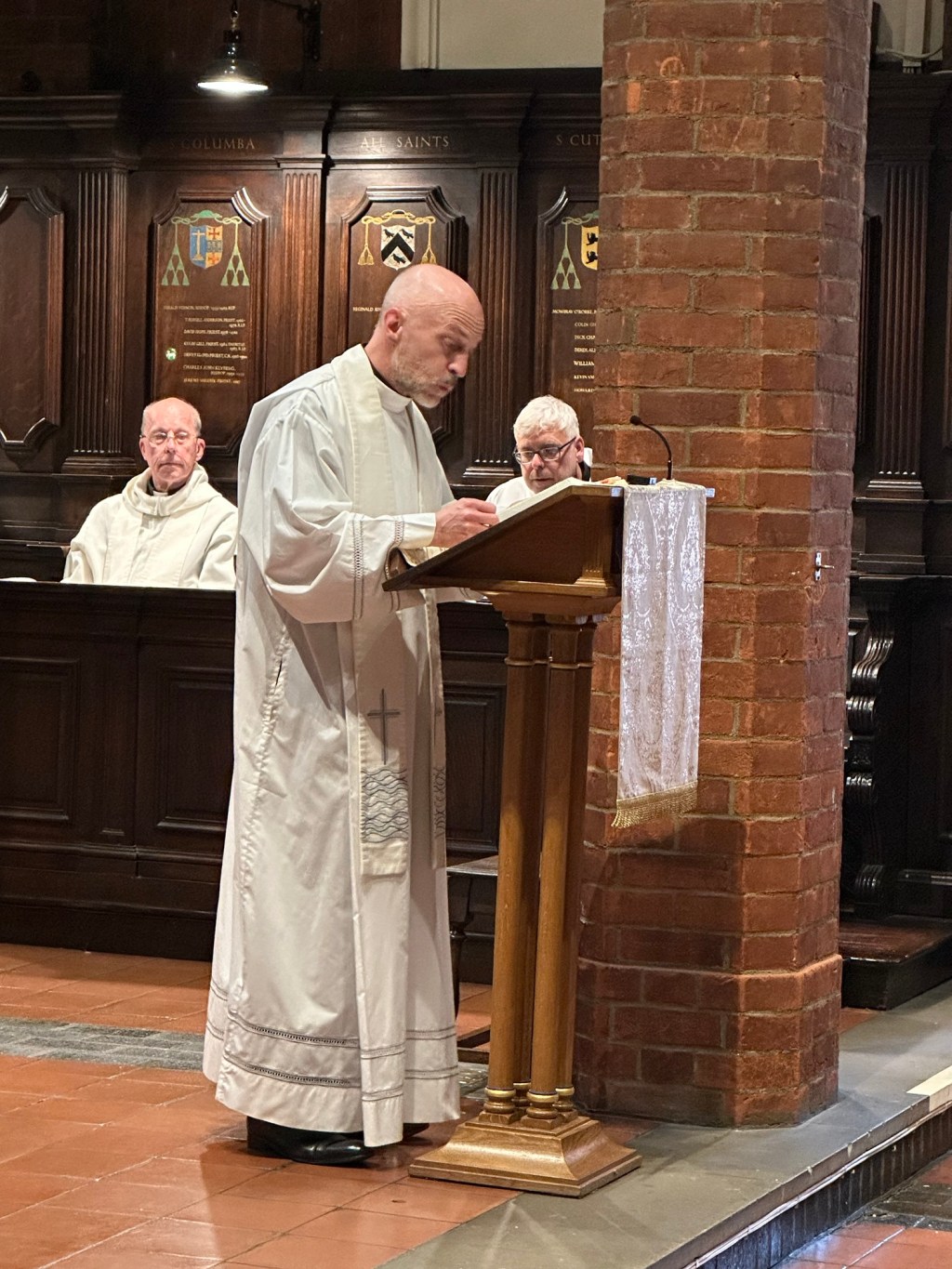
As we gather at the holy well on Tuesday morning for the rite of Sprinkling, Fr Richard Green reflects on John 4.3-19
Who is old enough to remember what a telegram is? In the olden days, you could send a message faster than the mail over telegraph wires, paying by the word. Telegrams were often popular at wedding receptions, where the best man would read out greetings sent to the happy couple.
I remember reading of a person who thought they would send a nice Bible verse to the newly-weds, and chose 1 John 4:18, “Perfect love casts out all fear”. To save money he just sent the Bible reference, and the couple then had to look it up. Unfortunately, the “1” at the start of the reference got missed off, so instead it became John 4:18, which reads “you have had five husbands, and the one you have now is not your husband”!
Why does Jesus say those words to the Samaritan woman he encounters at the well? Is it to embarrass her, or to mock her? I don’t think so. Instead, I think Jesus says this to indicate that he understands. He understands that her life has been complicated, and that she is an outcast from her community as a result. After all, why else would she be visiting the well alone in the hottest part of the day, when all the other women would come in a group in the early morning or evening? Jesus has already crossed boundaries of gender, religion and nationality by talking with her, so why shouldn’t he also cross the boundary of moral outrage as well?
This morning we are all like the Samaritan woman – don’t worry, I’m not casting aspersions about your love life! No, we are like her because we have all come to a well, and we have all come with a backstory; we come with lives full of complications and difficulties and problems and issues. Like the woman, we will encounter Jesus Christ, the Son of living God. And in that encounter, he will look into our heart, he will know what we bring to the well, and he will show us love, compassion and understanding. Above all, Jesus knows what we need, better perhaps than we do ourselves.
The Samaritan woman came to the well that day thinking that she knew what she needed – a bucket of plain old water, to take home for drinking, cleaning and cooking. But in reality, she needed something much more profound – she needed the live-changing experience that only the living water of Jesus could provide. It is that living water that we come to receive today, the water that quenches our real thirst, the water that cleanses our innermost selves. Today this living water washes over us, refreshes, renews and revives us. The water we receive from the well is not a magic potion: it does not guarantee to take all our problems away. But it enables us to live with those problems, issues and complications, as we are assured that Jesus knows us, loves us, and understands us.
There are so many lovely moments of interaction between Jesus and the woman in this passage, from which we can learn much. It’s a request from Jesus which launches that little discussion about her marital history. He says to her “Go, call your husband, and come back.” “Go, call, come” – it is an invitation, or instruction, to engage in the work of mission.
Yesterday we celebrated the wonderful feast of Mary Magdalene. In the Gospel from last night, the risen Jesus meets Mary outside the tomb, and says to her “go and find the brothers and tell them” the news of the Resurrection. “Go, call, come”; “go, find, tell” – Jesus is continually issuing this command to the unlikeliest of people – the outcast Samaritan woman, Mary Magdalene distraught with grief on the first Easter Day, and even you and me.
Yes, we receive something amazing here at the well. We receive that encounter with the Lord, and we receive the assurance of his unconditional love. But we also receive the call to share what we have received here, to take that living water, which cleanses, refreshes and revives, back to our homes, communities and churches, so that others may experience its transforming power.
 Enter the Mystery
Leave a comment