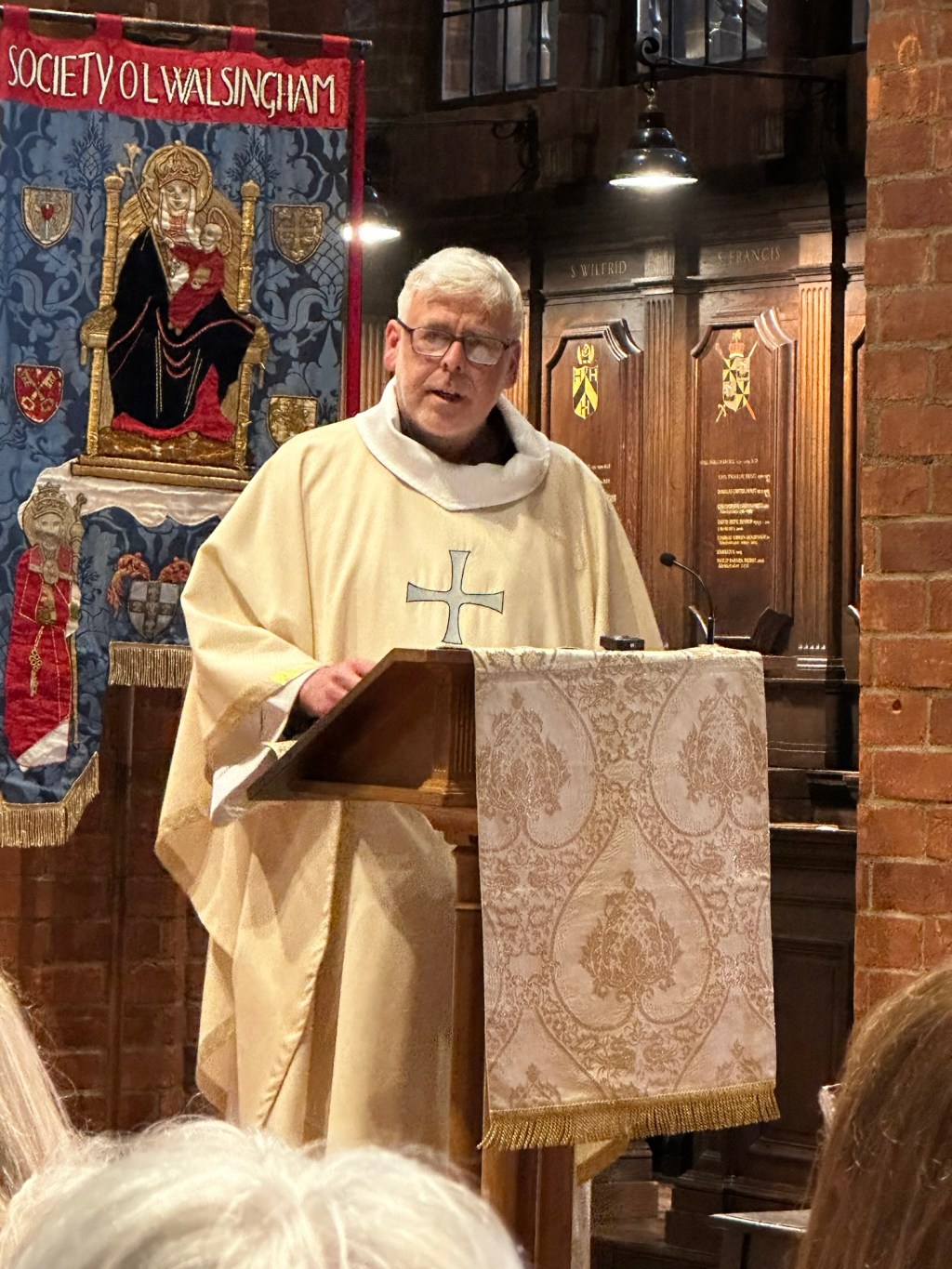
On the second day of our pilgrimage, we celebrate the Feast of St Bridget of Sweden, co patron of Europe. Fr Dean takes us on a journey from a festival of football, to crossing boundaries and how we discover God in surprising places
It’s 2017, and Cardiff is alive with festivities as football fans in their thousands find themselves there for the UEFA championship league finals. There are Fan zones and roadblocks, and police are everywhere, keeping order and helping to make everyone’s experience as good as it can be.
Just a few metres away from St Mary’s Church, there is one such roadblock and I’ve been talking to a copper from the valleys, chatting away. He’s really friendly and doing a great job. He’s diverting fans away from Butetown and down the alternative route to Cardiff Bay.
One woman breaks ranks. He shouts after her. “Don’t go down there, love. It’s not very nice.”
He turns back and I smile at him. “Thanks for that,” I say. “That’s where I live.”
We often make assumptions about people and even whole communities, cultures or countries based upon little evidence or experience of them. We’ve heard the stories. So, they must be true. We’re all prone to propaganda.
Likewise, some years ago, when I was appointed to one particular parish, a colleague of mine came across a member of the congregation in the street. Talking of my appointment, she said, “We expected so much more. He’s from the valleys.”
So often and so easily we dismiss people as having nothing or little to offer because of their background and our bias, the rumours and the rash assumptions we make, and maybe because of our own sense of insecurity and our need to be better than others.
I’ve been born and brought up and lived and worked in so many communities that have been stigmatised, derided and dismissed. And yet we often do the same to others, overlook what they have to offer, regard them as fruitless or pointless or worse.
What is the fruitfulness of which Jesus speaks in the gospel reading? It’s a bearing of fruit which comes from being close to Jesus, taking our life from Jesus, counting on him. Let’s allow St Paul to speak.
“I have been crucified with Christ,” he said, “and I live now not with my own life but with the life of Christ who lives in me.”
St Bridget was certainly fruitful! She was the mother of eight children. Married to a nobleman she didn’t take her aristocratic status for granted but spoke out against their excesses. She moved closer to the poor and the sick. Her life spilt over into mystical encounters with Christ of which she was wary, not knowing if they were from God or the devil. With a little discernment, and some help from another, she recognised these encounters as gifts from God.
When her husband died, she created a community of men and women to live together with Christ at its heart. She moved from grief to building something good, she continued to turn her heart to others.
What about our own communities? What do we hope for them? What does your community yearn for? What does your community seek? What does its heart love? What does it want? What does it need?
This is important because we cannot have a vision for the church unless it’s accompanied by a vision for the world of which we are a part. The Kingdom of God cannot be limited by our sometime narrow vision of the church.
And we can’t have a dream of global proportions if it doesn’t include a dream for the local and our own lives.
If we want peace in the world then we must begin where we are, working out our love for others by modelling that love close to home and embracing the opportunities on our doorstep. Like Bridget did. Like Mary did in that humble home of Nazareth, attending to Jesus hidden away from the limelight, doing the everyday things, attending to Jesus’ every need.
Darren McGarvey, a rap artist and social commentator, wrote about his life growing up on a tough council estate in Pollock where, he said, “violence was a part of daily life.” In his memoir, ‘Poverty Safari,’ he talks about growing up surrounded by violence both in his community and in his own home. This is what he writes after he recounts an incident at home at the age of five, when his mother, full of drugs and alcohol, chases him up the stairs with a knife, traps him in her room, and pins him to the wall, with a knife at his throat, only to be pulled from behind by others at the house.
He says, “Its hard to quantify what an experience like that does to a person and even harder to measure the long term impact as life unfolds. All I can say is that events like these, while seeming strangely normal at the time, later found expression in my beliefs about the world and all the people in it. For if you are not safe in your own home under the care of your mother, then where else could you possibly drop your guard?”
Home, of course, means different things to each of us. For some, like Darren McGarvey it wasn’t a safe place to be. It’s where he learnt about violence and how to be violent. But after many years he managed to begin to break free and find his own way in the world.
Our home is wider than the four walls we may be lucky enough to inhabit. So let’s go back to Butetown, and to the school celebrations at the end of the year where Year 6 pupils are lined up in front of a packed hall as they prepare to leave for High School.
Each, in turn, shares some of their favourite memories of their primary school years. Some stories are cute and funny, and there’s much laughter as they remember fun times on adventure holidays, falling off rafts, or generally being mischievous and laughing at each other in brilliant child like fashion.
And then, one girl steps forward. “My most precious memory,” she says, “is walking the border between Somalia and Somaliland.”
What a memory to have! Her feet are firmly in Wales, her head is somewhere else. The weight of history is upon her. Her heritage is unwrapped in a sentence. Her life is one of global proportions.
Each of us walks so many different borders and boundaries and sometimes we dare to cross them.
In that copper’s view, coloured by rumour as he stood at the edge of my community, that place where I live may “not be very nice.” But, to quote RS Thomas’ poem “The Kingdom” – “Inside it quite different things are going on.”
When it comes to the Kingdom of God, we have to be in it to win it.
And to transform our communities we have to cross the borders and boundaries and dare to stand in that common space where conversation can flow, and where we can listen and dare to dream dreams together, understand how different people tick, what brings them down, what raises them up.
Our vision for the church must be part of our vision of the whole world as we chase God’s kingdom which is just around the corner.
When we place ourselves into this space which the Eucharist inhabits we are saying to God that we want to be changed, and that we want the world to be changed. Transformed.
Caught up in God’s great love story which dares to take us to places we may have never been.
Do we really want to go down there to that place that’s “not very nice?” Or do we want to discover for ourselves the hidden beauty, the unlocked potential, the real stories, the full picture, and the connections that we can make.
Do we want to find out for ourselves what’s really going on there, wherever “there” is. And then, there, discover that Christ is already present, in the pain and the pleasure.
He has already crossed the boundaries. He has already walked the borders. He has made his home among us whether in the council estates of Glasgow, the badly represented Butetown, the dismissed Valley communities of South Wales, or those who walk the borderland of Somalia and Somaliland.
Don’t go down there.
What’s to stop us?
Why wouldn’t we?
After all, there you’ll find the one whom your heart loves.
He has been there before you. And he will be there when you leave.
 Enter the Mystery
Leave a comment