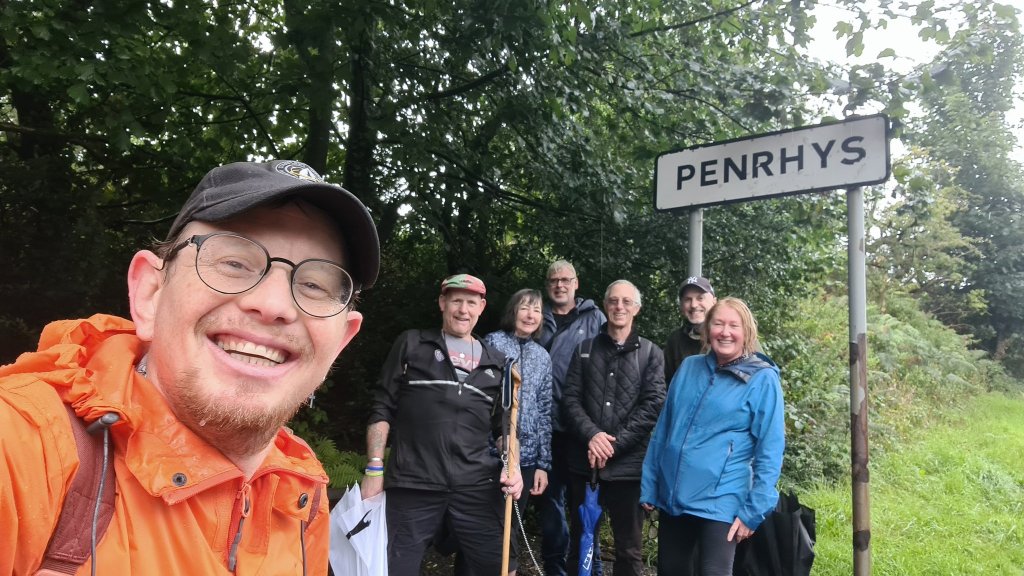
On Saturday 12th August, a band of pilgrims made their way on foot from the Church of Llanwonno in the Cynon Valley to the Shrine of Our Lady of Penrhys in the Rhondda. Crossing the mountain path – up hill and down hill and uphill again – it’s just a few miles, but the wind and the rain was against us! Fr Dean, one of the pilgrims, reflects on his walking pilgrimage to join others at the Shrine, befriending saints along the way.
I: St Gwynno’s Way
It feels dark and wintry. But it’s the middle of August. The rain and the evergreen trees of the forest, which embrace us as we leave our cars, disguise the season.
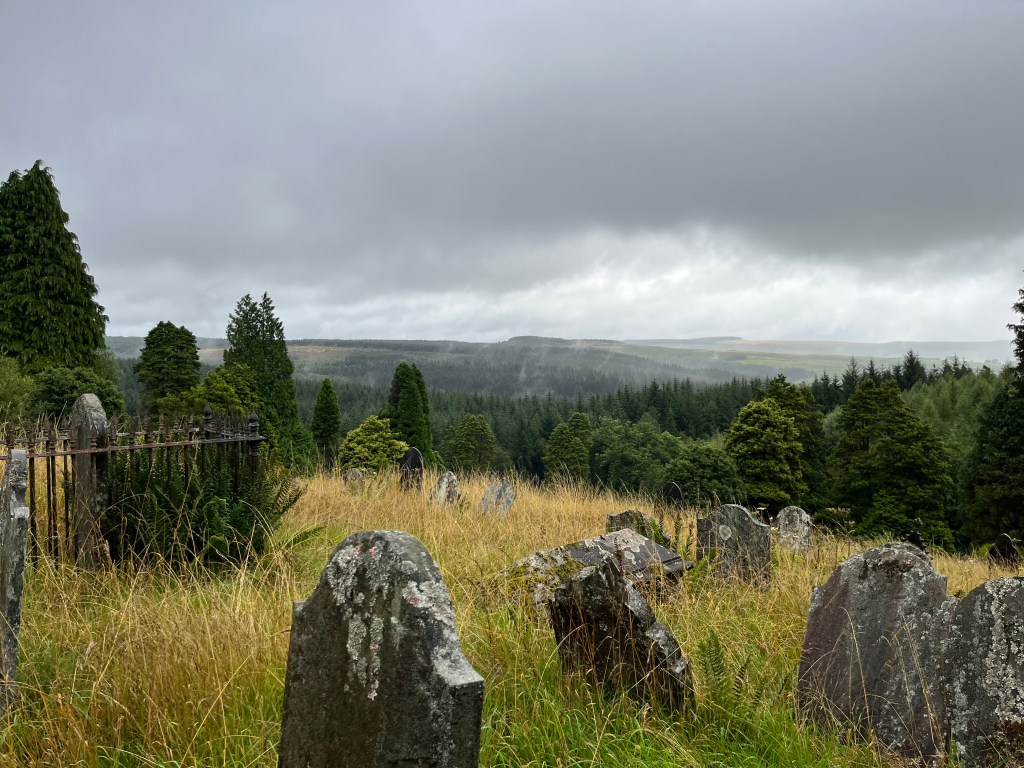
Dwarfed by trees and Gwynno’s grey church peeping out from the hill above us, we are greeted by the dead.
The graveyard which rolls down the hillside is substantial for a church where there is little evidence of human living apart from The Brynfynnon pub next door and which for now is asleep and closed for service being only 9 o’ clock in the morning. We peer in through the windows, see the tables set up for the lunch-time trade.
The graves date back to the 1600s and one in particular is regularly visited – that of Guto Nyth Bran, an athlete whose race through life has been intertwined with legend, and which ended with a slap on the back in 1737.
In some ways, he’s no different from St Gwynno who is swallowed up by legend and lost times, but he too left his name to this place of Llanwonno, although his own resting place is unknown. Many details of his life are lost, there are no miraculous stories or anecdotes told of him, unlike many of the Celtic saints.
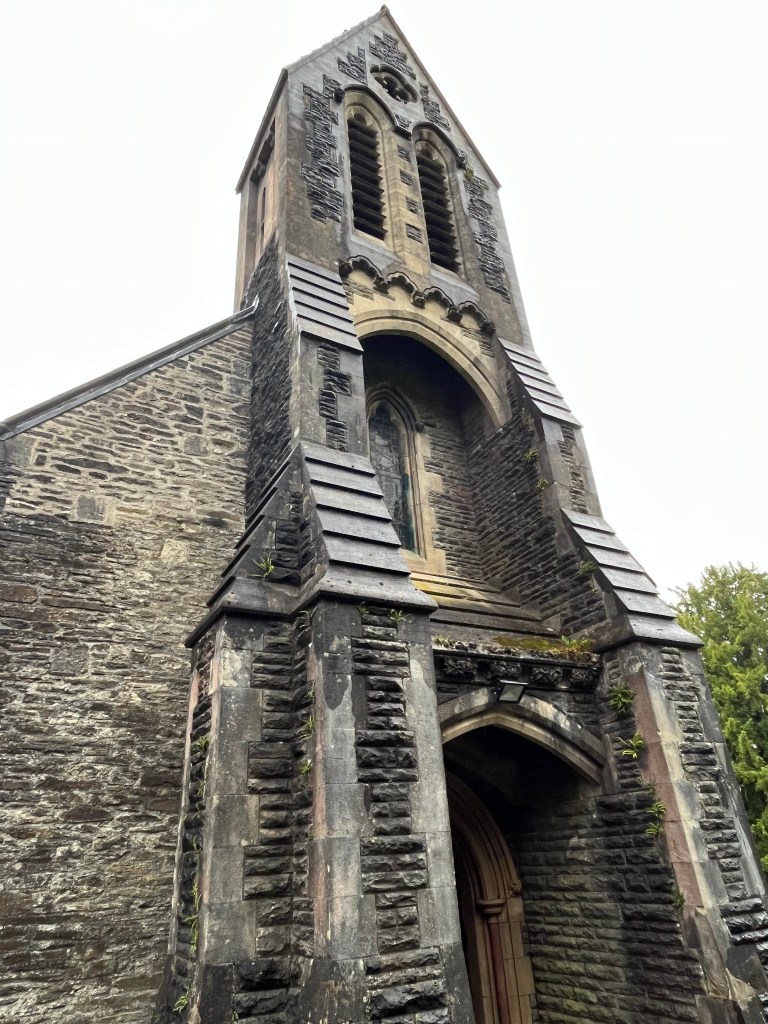
The church which stands in his name is built upon a much older church, probably made of timber or daub and wattle, well before the Normans came and built in stone. But it was here on the side of a wooded mountain that Gwynno lived, an extension of Llantrisant, nine miles away, and which in turn had grown from the great monastery founded by St Illtud at Llaniltud Fawr – or Llantwit Major as it’s often known.
Gwynno left these shores for a while, chased away by the Yellow Pestilence in the year 547. He fled to safety, like many others, to Brittany but soon returned.
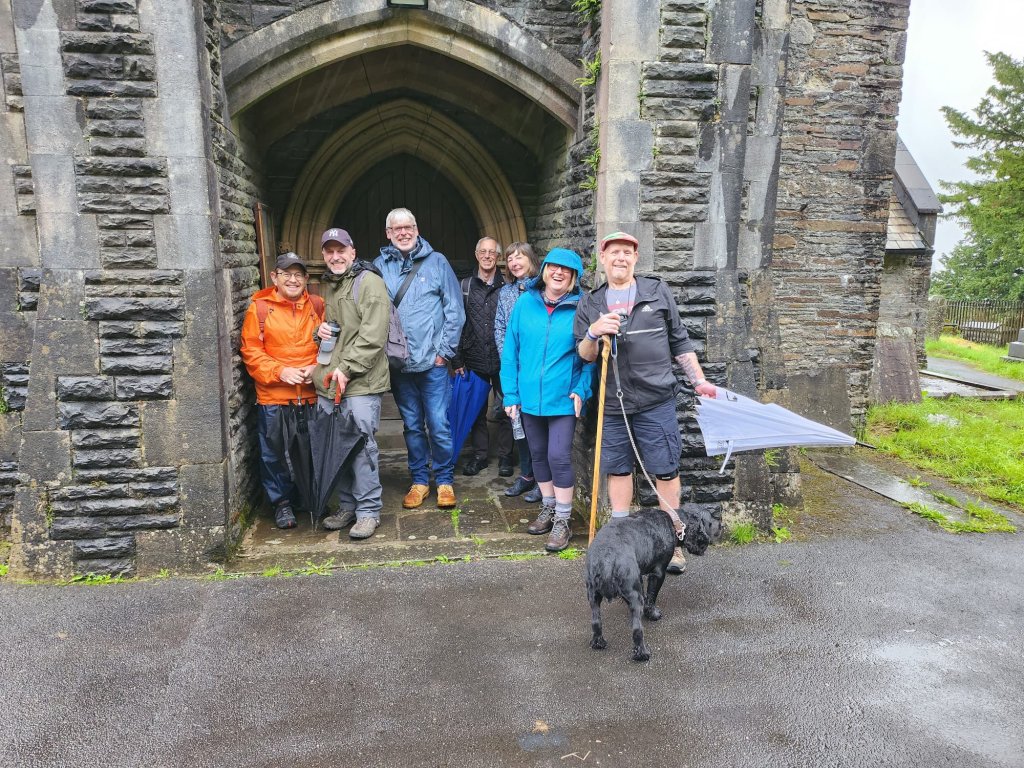
A few of us scurry out of the rain into the porch. There is some laughter as we wonder whether this is a good idea at all to walk across the mountain road from one valley to another, to the Shrine of Our Lady of Penrhys in the Rhondda.
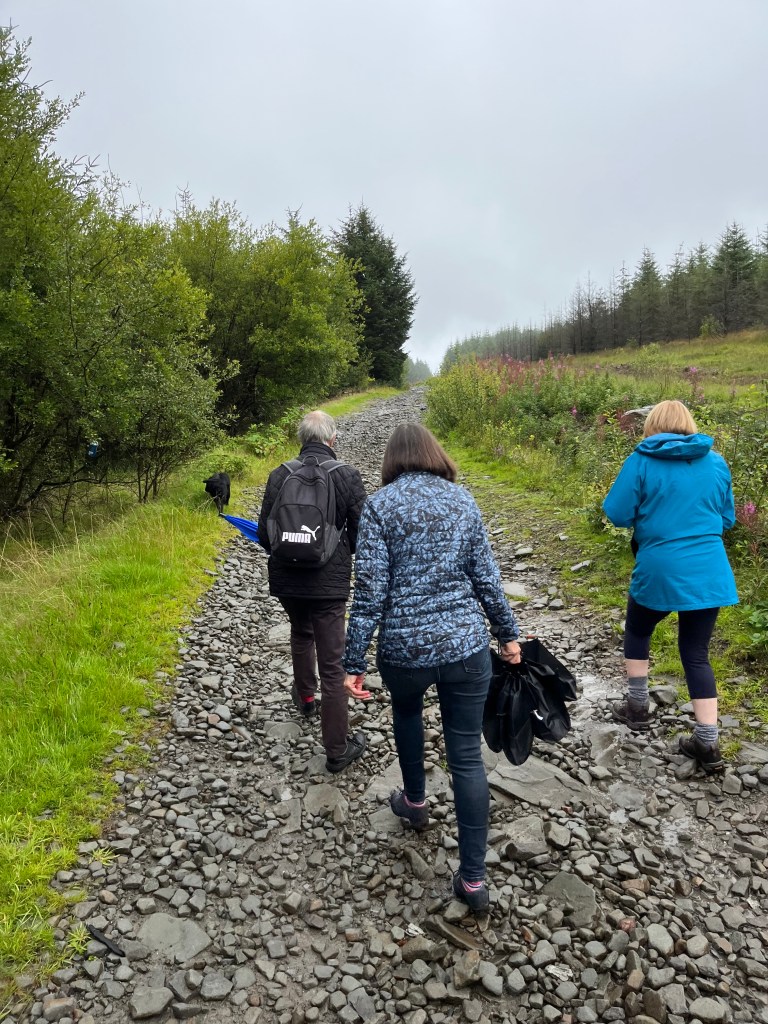
But we’re in good spirits. After prayer, we leave Gwynno’s ground, although his presence is felt across the paths which turn from stone to mud to pools of water, rubble, grass, wonder where his footsteps ever pressed into the ground.
The weather helps us pick up the pace. There are seven of us and a dog, Brennan, who chases scents, shakes off the rain, and walks or runs twice as far as any of us.
II: St Tyfodwg’s Way
As we rise over the mountain top and reach its curved summit, we see the misted mountains of another valley before us, as the houses of Penrhys provide the first glimpse of our journey’s end.
The dappled green of the valleys fights its way through grey skies and slate coloured rain. The view lifts our spirits. There is an intake of breath, feeding oxygen to the brain. We admire the beauty of this post-industrial landscape as nature fights back from its blackened past.
We pass through fields of horses. They are unbothered by the rain. They bray and jeer, calling to one another across dry stone walls, a secret language, a soundtrack for the soul.
Perhaps the lives of the Celtic Saints would have woven a miracle into this moment, like Columba and his own equine experience. In his lingering last days, after saying his final farewell to his brethren on the other side of the island of Iona, he stopped to rest. The white horse which had regularly carried the milk churns came close to him and laid his head upon Columba’s breast. The horse began to whinny and weep and foam at the mouth. Columba’s attendant drove the horse away but Columba stopped him.
“Let him alone, for he loves me,” said Columba. “Let him pour out his tears of grief here in my bosom. You, a man with rational soul, can know nothing about my departure except what I tell you. But this dumb creature, possessing no reason, has been told by the Creator himself that I am about to leave him.” So, he blessed his servant the horse; and the horse turned sadly way.
As we leave the horses and the farmhouse with its stables and neat dry stoned walls, we are unaware of when we cross from the Cynon to the Rhondda Valley. The landscape doesn’t change. There is no border or boundary, no sign to point the way, just the path we have taken and the view before us. Some boundaries are soft, hardly recognisable, not even known.
The whole of the Rhondda once formed part of the Parish of Ystradyfodwg, although the parish system was unknown to Gwynno and Tyfodwg who, alongside Illtud completes the trinity of Llantrisant saints.
There is, though, no sign of a church dedicated to Tyfodwg in this valley, no sign of a settlement, which throws doubts on whether the Rhondda can lay claim to him at all.
Rather, Tyfodwg’s church lies 8 miles west in Llandyfodwg in the next valley, and lies on the ancient pilgrimage route between Penrhys and St David’s. In the church there, is a twelfth or thirteenth century monument to a fallen pilgrim. He is shown carrying the symbols of pilgrimage to the Holy Land, Rome and Compestella. It’s thought the pilgrim may have been from Penrhys or, some say, even of St Tyfaelog himself.
We pass across a waterlogged path. None of us comments, but simply follow the person who has gone before, placing our steps where theirs have been.

III: St Illtud’s Way
As we descend to the valley, we skirt the streets of terraced houses of Stanleytown, walk the high bridge which spans the basin of the valley and the river which runs wild.
I try not to look down. The bridge is much higher than its approach suggests. Others, not perturbed by heights, stand a while and take photographs. And then we climb upwards again, wind our way through the car park of Lidl’s and stop for a short rest.
I meander outside, taking shelter beneath the canopy, moving now and then to make way for Saturday shoppers with pound in hand to release their trolley. Ater a while, I decide at last to wander inside and see what the others are up to, and maybe buy something to eat.
Immediately, I hear a voice addressing me. It shouts its way across the shop floor, asks me if I am shopping here. He reads the signs all wrong and thinks I have come in to use their toilet facilities which he says I can’t. Perhaps he needs a little more training in customer service, or maybe he just needs to learn to smile a little and relax. Or perhaps, wet and windswept, he makes little of me. I don’t spend a penny there, in any way!
Hospitality and welcome evades us, but there are many stories told in the lives of the Celtic Saints. When St Illtud escaped from the royal household, and settled in the place we now know as Llantwit Major, a stag bounded into his hut whilst he was deep in prayer.
A hoard of hounds arrived, hot on its heels, but strangely remained outside. They fell silent with heads bowed. A short time later, King Paulinus and his knights arrived, ordering the dogs to kill the stag but they remained still. In the midst of this strange chaos emerged Illtud who welcomed them in to eat.
At that moment, the stag poked his head out of the hut and stared at the scene outside. The King’s heart softened, and they crowded into the hut for a meal, whilst Illtud led the stag outside to lay with the hounds in peace.
“Does the bus pick up from here?” asks an older lady, interrupting my thoughts.
“I’m sorry, I don’t know. I don’t live here,” I reply.
“It’s just that I don’t want to walk up that hill,” she says, pointing to the road from the car park to the roundabout above us.
She glances at the rain, turns up the collar on her coat, and then goes for it.
The flask of coffee I had filled that morning and carried across the mountain has gone cold. I take a few cupfulls and then pour the rest into the drain. Its time to move on.
The old woman is ahead of us, still making her ascent with her trolly to the bus stop, where she eventually sits, and waits.
The longest climb is to come, up the steep incline of Penrhys Road, which winds its way alongside the cemetery on the right. It seems it’s where we had started, skirting the lives of the dead.
IV: Mary’s Way
The Holy Well which stands on the mountainside a few hundred yards from the image of Our Lady is overgrown, more overgrown than I have ever seen it since I first came here as a boy. It looks unkempt, sad, unloved.
The well is dry. There is no running water splashing out although, if there was, a sign placed on the gate advises us not to drink the water. “White wine runs on the rill that can kill pain and fatigue,” wrote Rhisiart ap Rhys in the fifteenth century. Today, there is no wine or water but maybe a little fatigue.
Back on the mountain top, at the site of the Medieval Church which once enshrined the image of Our Lady of Penrhys, other pilgrims begin to arrive for Mass. The weather has not put them off. “A goodly place it is,” wrote Lywellyn ap Hywel, “with its summits and wooded slope, and the Virgin sanctuary beside the deep forest.” I remember the deep forest back on Gwynno’s ground.
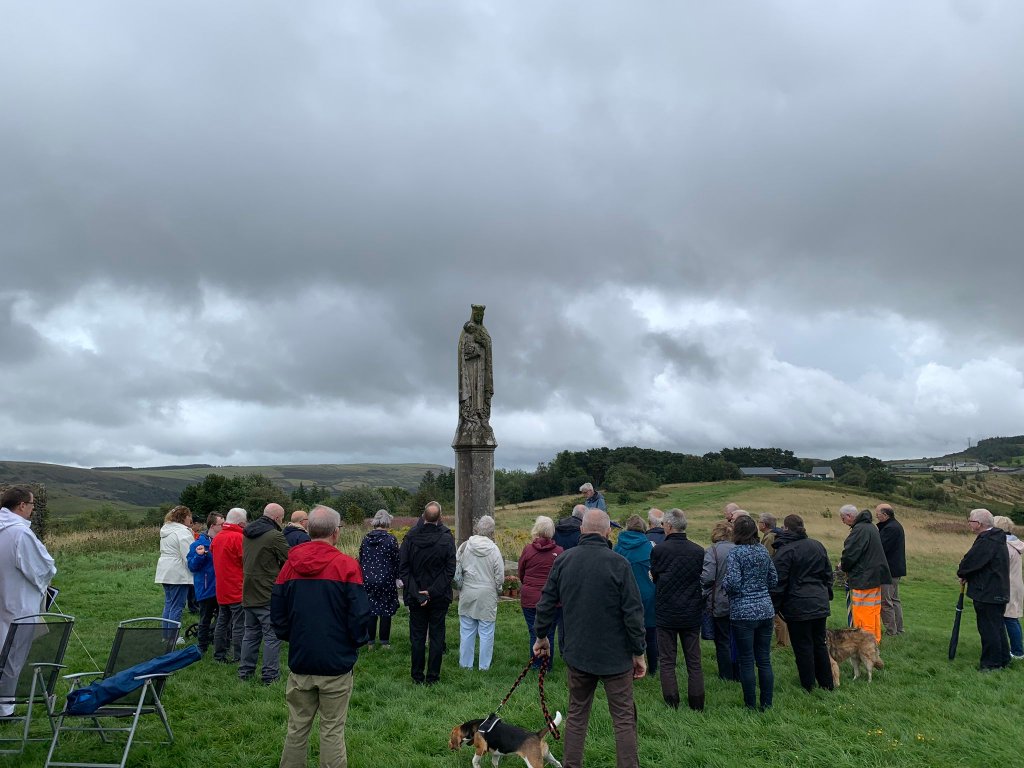
Here, beneath our feet are the foundations of the Church, marking out its Medieval territory, now long toppled. The present statue in Portland stone was placed here 70 years ago by the Archdiocese of Cardiff. The original image was taken under cover of darkness and burnt at Chelsea along with Our Lady of Walsingham. “It will not be all day in burning,” wrote Bishop Latimer to Thomas Cromwell.
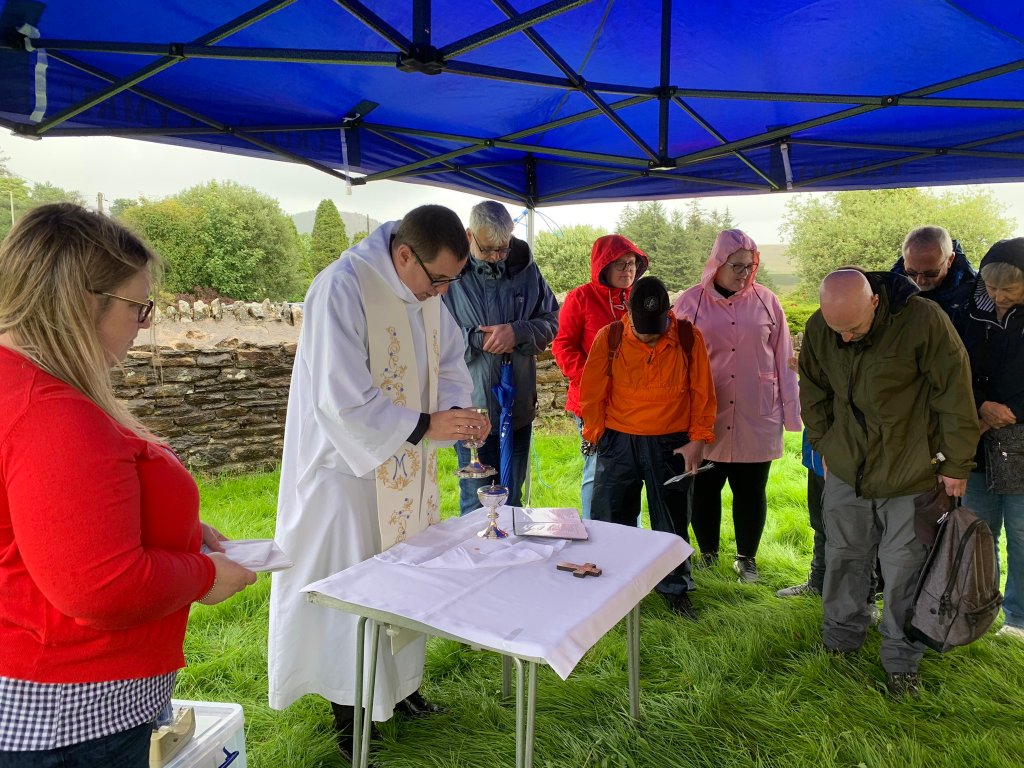
After prayers at the image of Mary “nursing Jesus for a kiss” we huddle beneath two gazebos which have been set up. By the time we begin Mass, there are more than fifty of us.
We watch the rain swoop in from the mountain on the other side of the Rhondda Fach. “It looks like locusts,” remarks one of our pilgrim walkers. More pilgrims huddle beneath the canopy.
Is this a new exodus? A constant trickle of pilgrims doing what pilgrims have always done, each journey unique, but connected with one another and with all those who have gone before, pressing a path into the land to make the journey easier for those who come after.
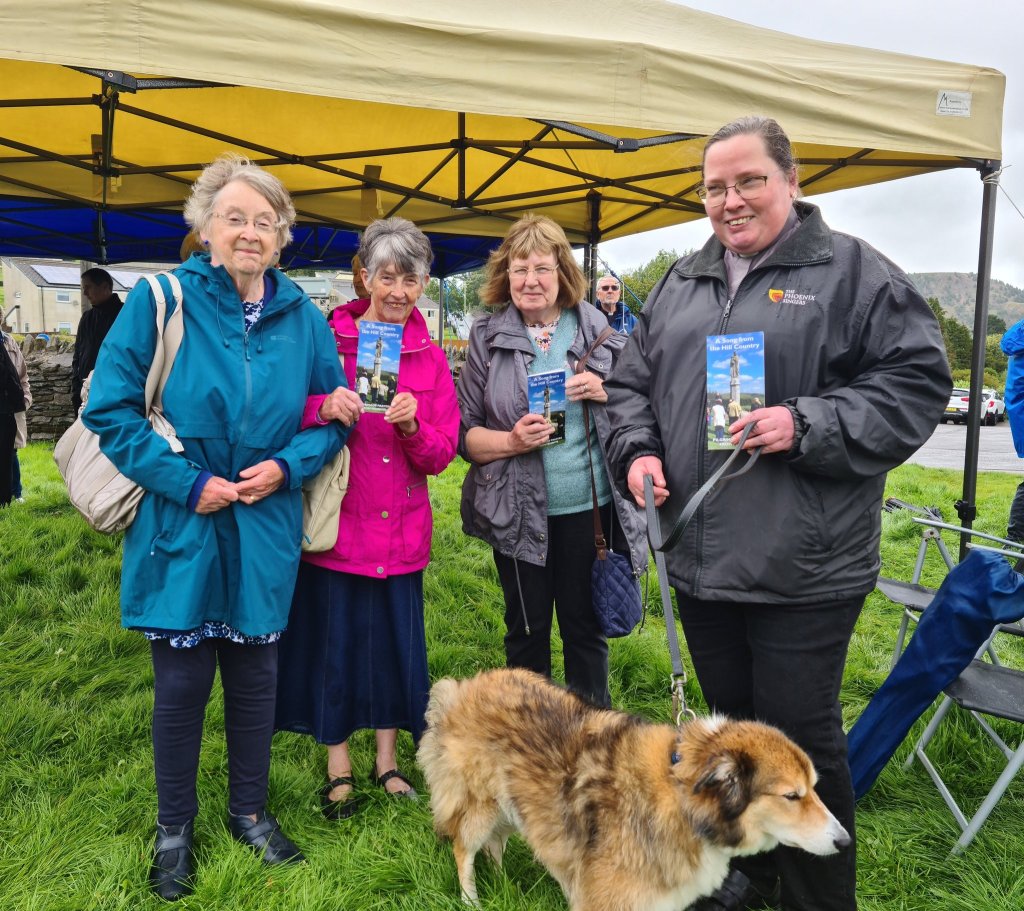
At Mass, we hear the Magnificat song of Mary proclaimed in the gospel reading, the song that filled the hill country of Judah. Here, in this ‘Land of Song,’ we listen for echoes of her voice.
The statue is strong, silent, resilient.
It seems to speak, somehow, in some way.
The Mass is over, and people linger to talk, but soon move on from the mountain. We watch the cars leave, one by one. We are the last to leave.
I look across the valley.
I hadn’t even noticed it had stopped raining.
 Enter the Mystery
Leave a comment