On the first evening of our pilgrimage, Fr Dean’s homily at the Mass of Our Lady of Walsingham reflects on the Magnificat Song of Mary, and asks who it’s for, and what it means for us.
Readings: Zephaniah 3:14-18; Luke 1:39-56
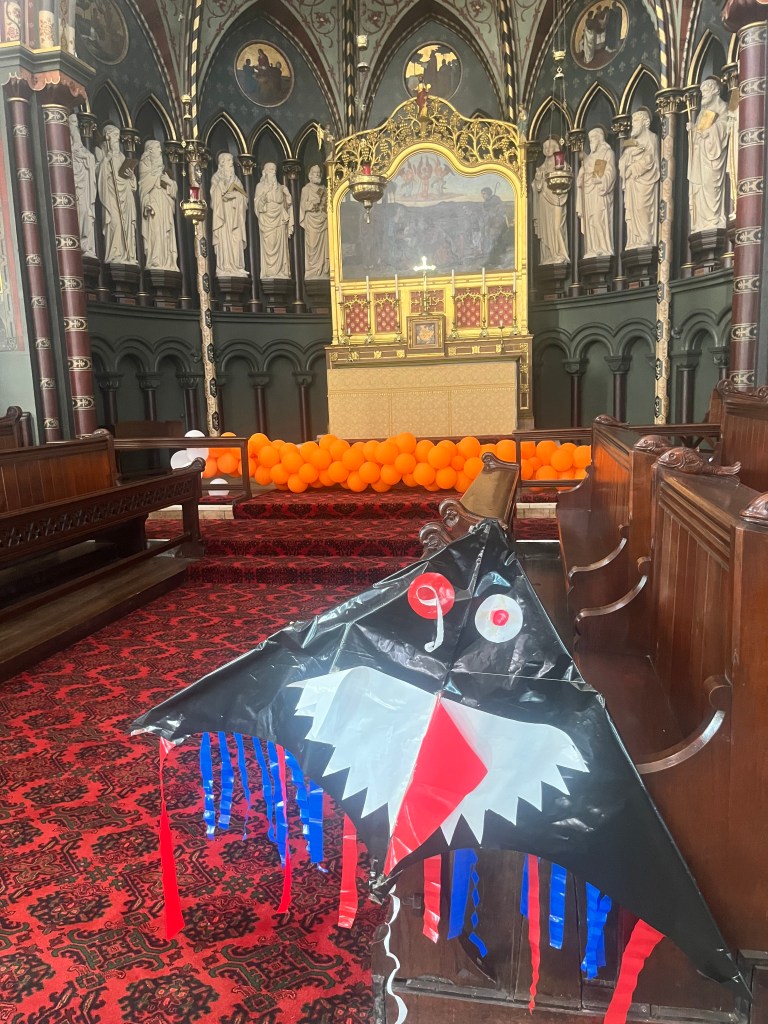
His eyes lit up
when he was told they’d be making kites in school that day.
He’s 11 years old,
And his name is Hamed,
and he’s been in this country
for just a year.

And as he leant in closer
to thread the cord,
through a hole he had made in the kite’s plastic,
eye to thread,
his face was intense,
so involved was he.

For him, this was a memory from home.

In his home of Afghanistan,kite flying is a national sport,
a local passion
something that children grow up with,as they look to the skies
filled with colour.

I’ve no idea what his journey had been like,
what he’d experienced,
whether or not he came through a legal route
or an illegal one
against the political promise and cry
of “Stop the Boats.”

But he is eleven.
And not a boat.
He’s just a boy
who loves kites.

Maybe that mountainous country
of Afghanistan
lends itself well to flying kites.

Amongst many other things,
the sport was banned by the Taliban,
which is why, during Refugee Week,
we thought it would be
a creative and colourful activity
for the children of St Mary’s School.

We had no idea
it would connect in such a way
with a child who, himself,
was a Refugee.

I’ll return to Hamed later.
We’ll leave him there,
with his kite
and his wide eyes
and his memory of home.

For now, let’s leave that mountainous country of Afghanistan
and move to another mountainous region,
the hill country of Judah,
close to Jerusalem,
and a few days’ walking distance,
south from Nazareth.

It’s where we pick up
that memory of a song
which connects with us,
that Song of Mary,
the Magnificat -
which we sang at the beginning of Mass
and which Mary shared
when she and her cousin, Elizabeth, embraced,
and they rejoiced
in all that God was doing
for them
and for the world.

As Mary moves from her Nazareth home,
with an angel’s message
alive in her life,
she connects with the song
of someone else,
the Song of Hannah.

Hannah had lost hope
of ever having a child.
In her song she gives thanks
for the birth of her son, Samson -
many years before Mary took her first breath.
Hannah praises God,
reflects on all that God is doing.

In her song, Hannah moves the music
from her own personal gratitude of being a mother
to something more global, more cosmic.
She rejoices in how God changes things,
reverses things,
transforms the world.

Mary takes Hannah’s song as her own.
It gives rhythm to her journey.
Every step is a prayer.
It’s music that moves her on.
How often have we done that
with someone else’s song,
and made it our own?

So we take Mary’s song
and fit it to our own lives
Mary’s Magnificat song becomes a song for us,
a song for all.

It’s a song of God’s Justice.
It’s a song of love,
of hope,
of promise.
God’s promise.
It’s a song that favours the poor,
and places the powerful in a precarious place.

It’s a song that declares fulfilment
for those who hunger and thirst.

It’s a song that sings for the vulnerable,
the weak, the “done-tos”
the “don’t haves”
the misunderstood,
the maltreated,
the mad,
and the minions.

It’s a song for the victims of other people’s success,
for those who have been pushed down
by those who have climbed high
upon their heads.

It’s a song for those who are stuck
between that polarising story
of ‘Them and us’
a story which is speedily being written in our world,
a story that divides people,
and paints people as villain,
when all they dream of
is a better life.

It’s a song for the prisoner,
individuals and communities
shamed and shackled
by a lack of opportunity,
a lack of investment,
a lack of care.


It’s a song for people who are silenced,
disempowered,
made to disengage from democracy
because others who seem to know better.

It’s a song for those who weep,
a song for those who long for a different life.

It is a song for Hamed.

I haven’t forgotten him.
I said I’d return to him,
and his wide eyes
as he tends to his kite,
his unknown past,
his fragile future,
as he is moved on,
yet again.

The botched Government Hotel scheme
means he has to leave his new found friends in Cardiff,
to live somewhere else again.

Will he ever be still?
At least he is safe,
I hope.

Our time here in Walsingham
at Mary’s house and home,
is a time, yes, to leave behind some of the distractions of life,
and to move with Mary,
closer to the heart of Jesus.

Although, if truth be told,
we don’t leave our burdens behind
but perhaps, here,
we hope for a fresh perspective,
a new way of looking at the world
and at our lives.

From this place
we hope to return home,
renewed and alive in the Spirit,
flying high,
like a kite
in the hills of Afghanistan.

Perhaps,
on our way home,
days from now,
we can dare to speak
those words of God’s Justice to the world
which Mary sang.
The music of God’s Kingdom.

What will you connect with this week?
What will you lean in to,
like Hamed with his kite
to be so intense and focussed
on that small thing,
that one moment,
which causes you to shine,
or to see life a little bit clearer,
to find some hope
and some meaning,
like that Magnificat moment of Mary,
and her music for the soul.

During our time together,
we will sing
and be silent.
We will laugh.
And some of us will cry.

We will reach to God
for hope
and for meaning
and maybe for
a miracle
or two.

Each of us has made this journey.
And here we are.

Spare a prayer for Hamed,
and so many others like him.

Enjoy your ‘kite moment,’
whatever that may be.
Lean in,
closely,
and intently,
with wide eyes,
and an open heart.

And may you have a share
in that Magnificat moment of Mary
when your heart
will be gladdened with joy.
 Enter the Mystery
Leave a comment