
The theme of this year’s South Wales Walsingham Pilgrimage is Mary’s Magnificat Song which she proclaimed in the hill country of Judah. As we prepare to make the journey, here’s a reflection on Mary’s Magnificat which will accompany us throughout the week.
Today,
funerals are often characterised by music,
favourite tracks are chosen,
or music that expresses something
that mourners can’t put into words,
a lyrical memory, a soundtrack of a life.

Hymns are often chosen from a popular few,
sometimes pulled from their childhood,
School Assemblies
and Sunday School times –
perhaps the last time they sang a hymn,
apart from on the rugby stand
on International Day.

As Mary makes haste her mind races too.
Every step turning the same thought
over and over again
as her journey gains momentum.

For Mary, the haste isn’t frantic,
although there is an eagerness
to reach her destination.
She is single minded, full of purpose:
to visit Elizabeth in her need:
to seek the company of someone
who will understand,
who knows what it means
to have her life turned around.
She delves into words and songs
that have filled her life,
and lined her faith

One resonates with her now,
the song of Hannah,
whose voice gives praise to God
for the gift of a child,
long awaited.

She makes those words her own,
so that when she arrives in the hill country
 they naturally take to her lips
as she praises God
in ‘Magnificat’ proportions.

Elizabeth, for some time now,
has been secluded, isolated.
As life grows within her,
she hides herself away.
We can only imagine why.
A time of hiddenness
keeping herself for God,
coming to terms with the miracle within.

Mary enters her seclusion,
shares in her hiddenness,
Elizabeth is aware of God’s presence,
within the womb of Mary.

Her own child too,
three months before his birth,
leaps for joy, kicks and dances,
waiting for a song.

Sometimes, we move with purpose,
know what we must do.
We know who needs us
and whilst we may not always know
how that will flesh out,
we can enter the seclusion of others:
welcomed in,
not with wise words or quick and clever fixes
like a long-awaited saviour
but simply to be alongside.

Companionship can create
its own miracles of healing
as we stand alongside,
take the knee,
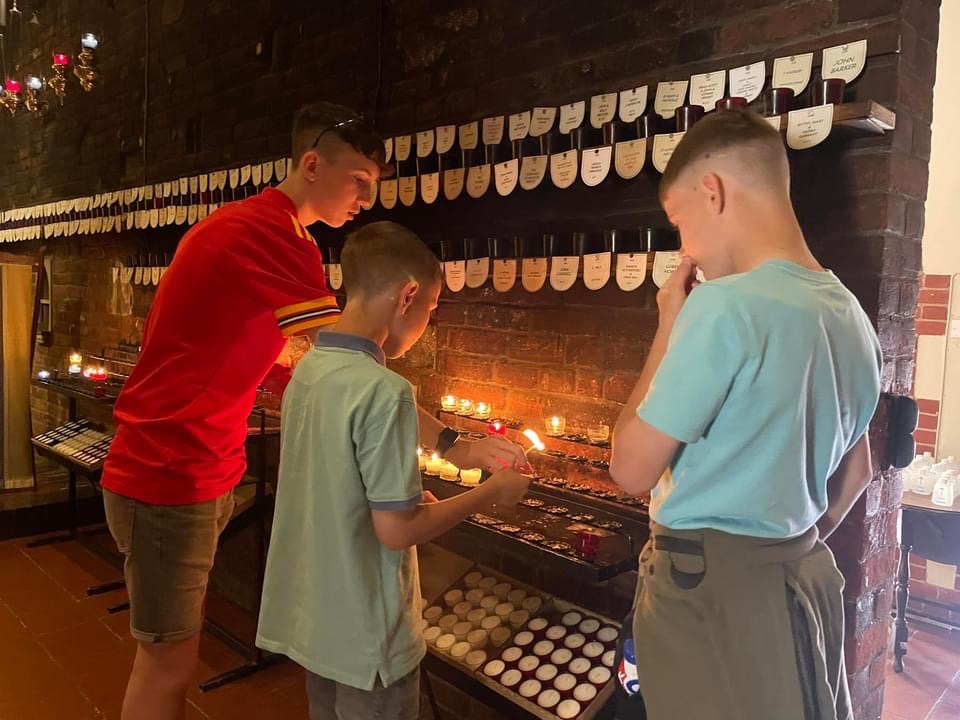
share the flame of a vigil light,
talk the same talk,
sing songs of justice,
put the kettle on,

clap for carers,
listen to the same words,
over and over,
wait for the last breath.

Being useless in a useless situation
sometimes has its uses.

For Mary, in her haste,
also carries with her the presence of Christ,
and we, too, though so unlike her are
also so much like her,
called to welcome Christ
to carry him in our lives,
like cracked and broken vessels.

She sings the song of the hill country,
a song of praise to God.
Mary, in her littleness,
and in her haste and waiting,
has discovered the joy of living
in God’s presence.

The Magnificat is the soundtrack of her life.
It’s a song we take to heart,
its lyrics are filled with love
and maybe, just maybe,
the sound of it made John leap for joy again.
Gospel of the Visitation of Mary the Elizabeth
In those days Mary set out and went with haste to a Judean town in the hill country, where she entered the house of Zechariah and greeted Elizabeth. When Elizabeth heard Mary’s greeting, the child leaped in her womb. And Elizabeth was filled with the Holy Spirit and exclaimed with a loud cry, “Blessed are you among women, and blessed is the fruit of your womb. And why has this happened to me, that the mother of my Lord comes to me? For as soon as I heard the sound of your greeting, the child in my womb leaped for joy. And blessed is she who believed that there would be a fulfilment of what was spoken to her by the Lord.” (Luke 1:39-45, NRSV)
 Enter the Mystery
Leave a comment